Resources · Freight forwarding
What is a freight forwarder? A guide to 1PL–5PL logistics.
Freight forwarders are the connective tissue of global trade — the people who turn a purchase order in one country into a delivered pallet in another. This guide explains what forwarders actually do, when it makes sense to hire one, and how the 1PL through 5PL logistics levels differ.
What a freight forwarder actually does
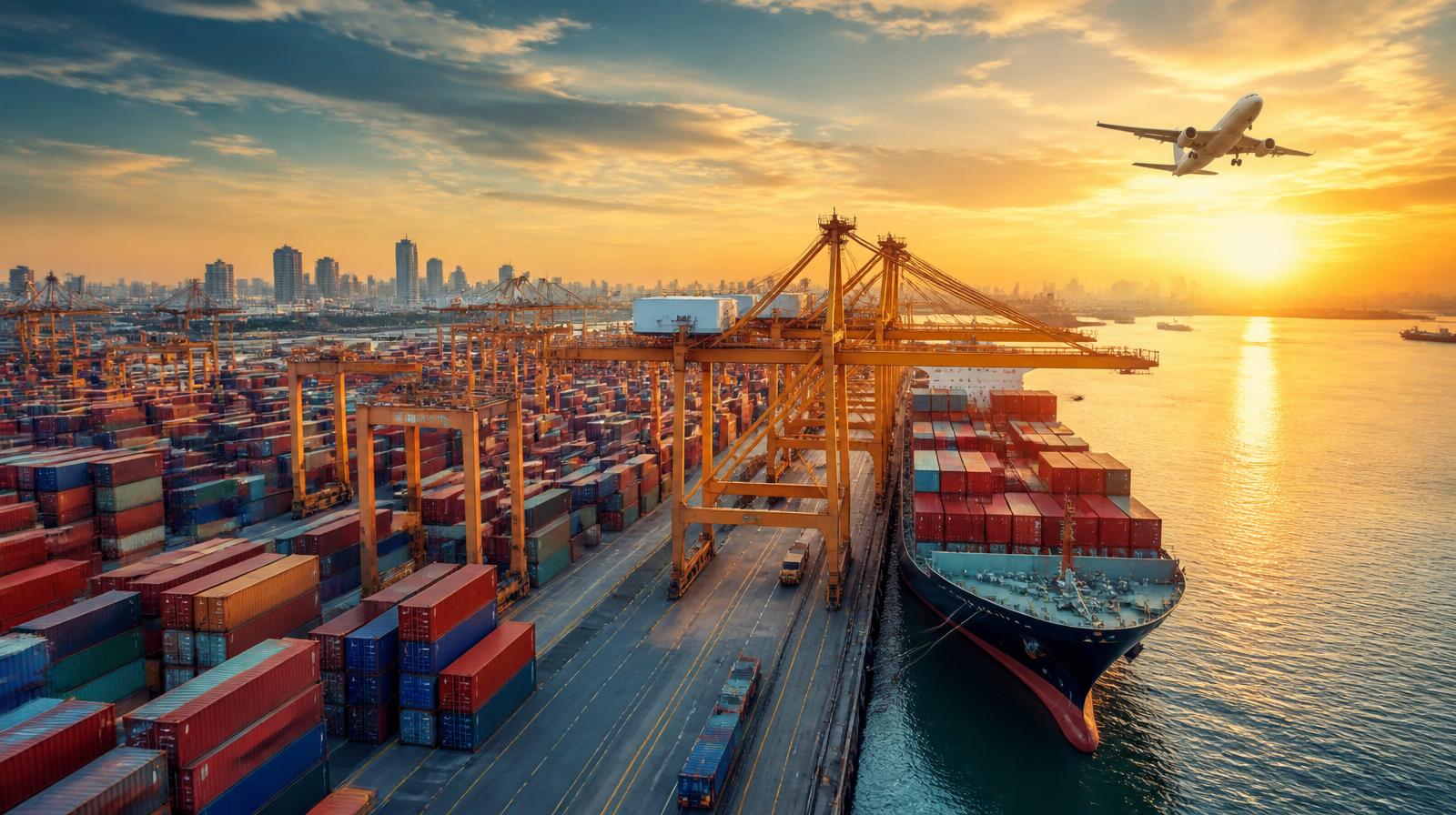
A freight forwarder is a logistics specialist that arranges the international movement of goods on behalf of a shipper. Forwarders don't usually own ships, aircraft, or trucks — they buy capacity in bulk from carriers, then resell it to businesses along with the services that make a shipment actually work: booking, documentation, customs clearance, insurance, and milestone tracking end-to-end.
In practice, a freight forwarder handles most or all of the following:
- Quoting rates and transit times across ocean, air, and road options
- Booking capacity with carriers and confirming schedules
- Preparing export and import customs documentation
- Arranging pickup at origin and delivery at destination
- Consolidating multiple shippers' cargo into shared containers or ULDs
- Managing warehousing, cross-docking, and 3PL fulfilment
- Tracking shipments and flagging exceptions before they become delays
- Providing cargo insurance and handling claims
When do you need a freight forwarder?
For a single parcel, an integrator like DHL, FedEx, or UPS is usually enough. Once shipments reach a few pallets per month, cross a border, or involve special handling — reefer, hazmat, out-of-gauge — a forwarder typically saves money and headaches. They negotiate rates on your combined volume, take responsibility for customs, and know which lanes are actually reliable this quarter.
Logistics levels
The 1PL to 5PL ladder.
Every logistics provider fits somewhere on the 1PL–5PL scale. The higher the number, the more of the supply chain the partner owns or orchestrates.
First-party logistics
The shipper moves its own goods with its own trucks, drivers, and warehouse. Common for local producers delivering directly to nearby customers.
Best fit: Small local businesses, farm-to-market operators.
Second-party logistics
An asset-owning carrier — a shipping line, airline, or trucking company — hauls the goods on a specific leg. The shipper still manages the overall shipment.
Best fit: Companies that book directly with carriers and manage documentation in-house.
Third-party logistics
A logistics provider — usually a freight forwarder — arranges and executes transport, warehousing, and customs on the shipper's behalf, often across multiple modes.
Best fit: Businesses that want to outsource execution but keep supply-chain strategy in-house.
Fourth-party logistics
A lead logistics partner designs and manages the whole supply chain — orchestrating multiple 3PLs, carriers, and IT systems as a single point of accountability.
Best fit: Mid-market and enterprise shippers with complex, multi-region networks.
Fifth-party logistics
A 5PL layers analytics, automation, and network-wide optimization on top of 4PL orchestration — typical of e-commerce marketplaces and digitally native shippers.
Best fit: Data-driven shippers running high-velocity, omni-channel fulfilment.
3PL vs 4PL: the practical difference
The line between 3PL and 4PL is the most useful one to understand. A 3PL executes — it runs warehouses, moves freight, and clears customs. A 4PL orchestrates — it designs the network, picks the 3PLs, integrates the IT, and hands the shipper a single point of accountability. Many freight forwarders operate as a 3PL by default and step into a 4PL role when the customer wants network design and vendor management on top of execution.
A useful test: if the partner would be replaced when volumes double, they are acting as a 3PL. If they would redesign the network to absorb the new volume — adding a hub, swapping a carrier, renegotiating rates — they are acting as a 4PL. Most mid-market shippers start with a 3PL relationship and let it evolve as trust and complexity grow.
How freight forwarders price a shipment
Freight quotes look opaque because they bundle several line items. Ocean and air rates are usually quoted per container (FCL), per cubic metre or kilogram (LCL / air), plus origin and destination handling, documentation, customs entry, and any surcharges the carrier is passing through — bunker, security, peak-season, currency adjustment. A transparent forwarder itemizes these instead of hiding them in a single "all-in" number, which makes it easier to compare quotes and see where the cost actually sits.
The other half of pricing is the Incoterm — EXW, FCA, FOB, CIF, DAP, DDP and the rest. The Incoterm decides which leg of the journey the seller pays for and where risk changes hands. A good forwarder will ask which Incoterm you're shipping on before quoting; if they don't, that's a sign to keep shopping.
Modes: ocean, air, and road
Ocean freight is the workhorse of international trade — cheapest per kilo, slowest by weeks, priced per full container (FCL) or per shared slot (LCL). Best for anything not urgent and not fragile.
Air freight is the opposite: five to ten times the cost of ocean but measured in days, not weeks. Reserved for high-value, time-critical, or perishable cargo, and for recovering when an ocean plan slips.
Road freight handles the first and last mile of almost every international shipment and the full trip inside a continent — full truckload (FTL), less-than-truckload (LTL), or groupage. In Europe, road is the default mode for anything moving between EU member states.
How to choose a freight forwarder
- Coverage on the lanes you actually use — not just a global map
- Licensed customs brokerage in your import countries
- Own or trusted warehouse footprint near your customers
- Milestone visibility that integrates with your ERP or OMS
- A named account manager, not a shared inbox
- Certifications: IATA, FIATA, AEO, C-TPAT where relevant
- Transparent, itemized quotes with surcharges called out separately
- A track record on your specific cargo type — reefer, hazmat, project cargo
A quick glossary
- Bill of lading (B/L)
- The carrier's receipt for the cargo and the contract of carriage. In ocean freight, the original B/L is also a title document — whoever holds it can claim the goods.
- HS code
- The Harmonized System tariff code that classifies your product for customs. Wrong HS code = wrong duty rate and a potential customs hold.
- FCL / LCL
- Full container load vs less-than-container load. FCL is your own container; LCL means your pallets share a container with other shippers' cargo.
- Demurrage & detention
- Penalty fees when a container sits at the port (demurrage) or off-port past its free time (detention). Avoidable with tight planning.
- Incoterms
- The 11 international commercial terms (EXW, FOB, CIF, DAP, DDP, etc.) that split cost and risk between buyer and seller.
Need a freight forwarder for your next shipment?
VP Logistics runs the full 3PL stack — ocean, air, road, warehousing, and customs — across 45 countries. Share your route and cargo; we'll come back with pricing and a plan within one business day.